
The ongoing geopolitical tensions involving Iran have once again placed the Dubai real estate market under close scrutiny from global investors.
As concerns about regional stability emerge, the Dubai real estate market is facing questions about whether the Iran conflict could disrupt one of the world’s most dynamic property ecosystems.
While geopolitical developments often influence investor sentiment, the Dubai real estate Market has historically demonstrated resilience during global and regional crises.
Assessing the potential implications of the Iran conflict requires examining both the strong market fundamentals currently in place and the historical performance of Dubai’s property sector during previous disruptions.
Dubai Real Estate Market: Record-Breaking Momentum
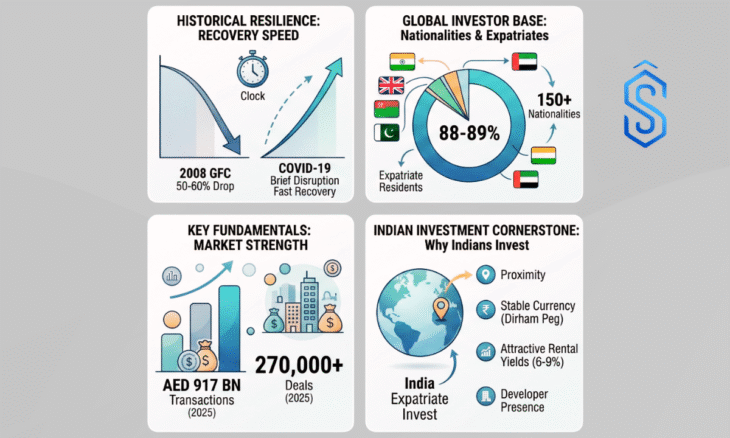
The Dubai real estate market entered the current phase of geopolitical uncertainty from a position of considerable strength. In 2025, the emirate recorded approximately AED 917 billion (around $250 billion) in real estate transactions – the highest annual transaction value in its history.
Transaction volumes surpassed 270,000 deals, indicating strong liquidity and sustained investor participation across property segments. Residential properties played a particularly significant role in driving the expansion of the Dubai real estate market.
Nearly 200,000 residential transactions worth around AED 538 billion were completed during the year. Since 2021, residential property prices have surged by roughly 60–75%, making the Dubai real estate market one of the strongest-performing housing markets globally during the post-pandemic recovery cycle.
Also Read: Academic Real Estate Supercycle: India’s Higher-Education Sector Eyes 2.7 Billion Sqft Expansion
Investor Psychology
Strong growth cycles often influence how markets react to geopolitical shocks. In the case of Dubai market, periods of expansion tend to result in temporary slowdowns in transaction activity rather than immediate price corrections.
However, the latest geopolitical developments introduce a new dimension. Reports of attacks reaching parts of the UAE have tested Dubai’s long-standing reputation as a secure economic hub in the Middle East.
While the physical damage has been limited, the psychological impact on global investors monitoring the Dubai real estate market cannot be overlooked.
Investor sentiment often plays a critical role in highly internationalised property markets, and perception risks may influence short-term investment decisions.
Wait-and-Watch Approach in Off-Plan Property Segments
The Dubai market relies heavily on international investors and expatriate residents. When geopolitical risks increase, investors may temporarily adopt a “wait-and-watch” approach, particularly in segments driven by speculative activity.
Off-plan property purchases are typically the first to experience such sentiment shifts. These investments depend strongly on future market expectations and investor confidence. As a result, the Dubai market could witness a moderation in off-plan sales if geopolitical uncertainty persists.
Nevertheless, such slowdowns historically tend to be temporary, especially when the broader economic and demographic fundamentals remain intact.
Tourism and the Dubai Real Estate Market
Tourism represents another important channel through which geopolitical tensions could affect the Dubai Real Estate Market. The broader Middle East tourism sector is estimated to generate approximately $367 billion annually, making it a critical pillar of regional economic activity.
Industry estimates suggest that prolonged instability could result in 23–38 million fewer visitors, potentially translating into a $34–56 billion decline in tourism revenues across the region.
If such a scenario materialises, the immediate impact could be felt in short-term rental apartments, hospitality assets, and retail properties located in tourist-centric districts. These segments are closely linked to visitor inflows and travel sentiment.
However, residential demand within the Dubai Real Estate Market is not solely dependent on tourism. Dubai’s large expatriate population continues to provide a stable base of long-term housing demand.
Also Read: Workplaces 2025: India to Host 2,400 GCCs and 2.8 Million Jobs by 2030, Says FICCI-ANAROCK
A Globally Diversified Investor Base
One of the most important structural strengths of the Dubai Real Estate Market is the diversity of its investor base. Property buyers from more than 150 nationalities participate in Dubai’s real estate sector, making it one of the most internationally diversified property markets in the world.
Expatriates account for approximately 88–89% of the UAE’s population, creating sustained demand across multiple housing segments ranging from affordable housing to luxury properties.
This diversified participation reduces reliance on a single investor group and contributes to the overall resilience of the Dubai Real Estate Market.
Indian Investors and the Dubai Real Estate Market
Indian nationals play a particularly important role in the Dubai Real Estate Market. They represent the largest foreign investor group, accounting for approximately 20–22% of foreign property purchases in the emirate.
Several factors drive Indian investment in the Dubai Real Estate Market, including:
- Geographical proximity between India and the UAE
- The UAE dirham’s peg to the US dollar, providing currency stability
- Attractive rental yields typically ranging between 6% and 9%
These yields are among the highest globally for a major international property market, making the Dubai Real Estate Market an attractive destination for investors seeking both capital appreciation and rental income.
Expansion of Indian-Origin Developers in Dubai
The presence of Indian developers within the Dubai Real Estate Market has also grown steadily. While major local developers such as Emaar, DAMAC, Nakheel, and Meraas continue to dominate the sector, Indian-origin developers are estimated to contribute 8–10% of the overall development pipeline.
Developers such as Sobha Realty have established a strong presence with projects like the Sobha Hartland community, spanning nearly 8 million square feet.
Similarly, Danube Properties has launched more than 20 residential projects in the emirate. Other Indian-origin developers, including Shapoorji Pallonji Real Estate and Casagrand, have also expanded into the Dubai Real Estate Market through premium residential developments.
Lessons from Two Decades of Real Estate Cycles
The Dubai Real Estate Market has experienced several major cycles over the past two decades.
During the 2008 global financial crisis, property prices declined by approximately 50–60%, and the sector required nearly six to seven years to fully recover.
Another correction occurred between 2014 and 2019, when prices fell by 25–30%, largely due to lower oil prices and concerns about oversupply.
In contrast, the COVID-19 pandemic caused only a short-lived disruption. The Dubai Real Estate Market recovered within 12–18 months, demonstrating significantly stronger resilience compared to earlier cycles.
These historical patterns highlight a key characteristic of the Dubai Real Estate Market: while corrections can occur, the sector has consistently shown the capacity to recover once investor confidence returns.
Short-Term Caution, Long-Term Outlook
The current geopolitical tensions involving Iran may introduce short-term caution among investors in the Dubai Real Estate Market. Transaction volumes could moderate as buyers assess the evolving regional risk environment.
However, Dubai’s position as a global financial hub, tourism destination, and international lifestyle city, combined with its diversified investor base and flexible regulatory framework, continues to provide structural support for the Dubai Real Estate Market.
The key question is not whether geopolitical tensions will influence the market in the short term — they almost certainly will. Instead, the more relevant issue is how quickly investor confidence returns once the geopolitical environment stabilises.
If historical patterns offer any guidance, the Dubai Real Estate Market has repeatedly demonstrated an ability to recover faster than many global property markets following periods of uncertainty.